

On Thursday, February 12, 2026, the UC Santa Barbara Center for Latin American and Iberian Research (CLAIR) and the Awakening Languages: Actions for Revitalization and Maintenace (ALARM) Lab hosted a presentation titled “The Power of Partnership: Revitalizing Limonese Creole (Costa Rica) Through Joint Action.” The event centered on Limonese Creole, the most widely spoken minority language in Costa Rica, with around 60,000 speakers, which has faced linguistic social stigma and exclusion from constitutional recognition. The presentation examined both the challenges this language community has endured and the collaborative strategies they have used to strengthen logistic visibility, cultural pride, and political recognition.
The featured speaker, Dr. René Zúñiga Argüello of the National University of Costa Rica, leads the Programa de Lingüística Centroamericana (PROLINCA). With decades of experience in language documentation and planning, Dr. Zúñiga Argüello outlined the partnership between PROLINCA and the Limonese Creole-speaker community as a model of community-centered language revitalization. Moderated by UCSB Linguistics Professor Jaime Pérez González, the talk drew on linguistic theory and policy initiatives to illustrate how academic-community partnerships can produce tangible gains for historically marginalized languages.
Dr. René Zúñiga Argüello has been Coordinador de Licenciatura y Ciencias del Lenguaje at the Universidad Nacional de Costa Rica since 2007. When he first began his research on Limonese Creole, he was asked to make grammatical descriptions of the language. It marked the beginning of a sustained collaboration with the Limonese Creole community to develop linguistic and educational materials that they can use to demonstrate and advocate for recognition of the language’s legitimacy.
Professor Zúñiga Argüello explained the history of Limonese Creole, which emerged from contact among English and several West African languages, such as Wolof, Akan, Yoruba, and Hausa, during the colonial period in Jamaica. Between 1872 and 1949, Afro-Caribbean workers, primarily from Jamaica, migrated to Costa Rica to work in construction and the coffee industry. Many Jamaicans settled in Limón, where they remained socially and geographically isolated from the rest of Costa Rica. They maintained elements of Jamaican culture and linguistics, and Costa Rica’s dominant national identity was strongly influenced by the Spanish language and Catholic education.
Dr. Zúñiga Argüello presented the increased stigmatization, loss of linguistic domains, and linguistic identity due to internalized discrimination and linguistic national ideologies that privileged Spanish as the sole marker of Costa Rican identity. As well as internal linguistic attitudes categorizing Limonese Creole “broken” English rather than recognizing it as a fully developed Creole language. In 2009, Dr. Zúñiga Argüello began his work on descriptive grammar, but faced backlash from members of the Limonese Creole-speaking community because he was not from the language community. However, he continued to give workshops similar to this one and shifted toward a more community-centered approach.
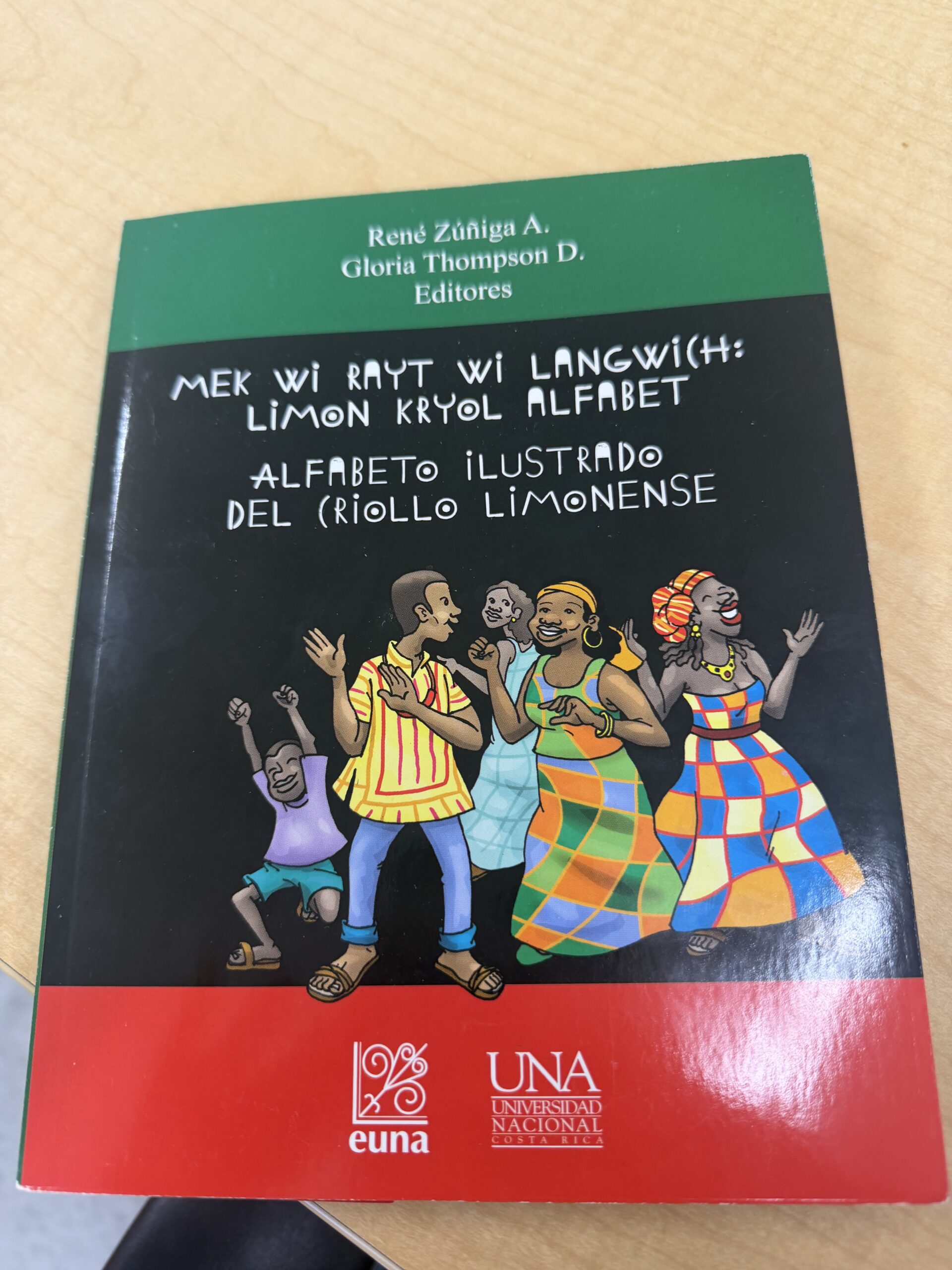
A major milestone in this collaborative work was the development of an illustrated alphabet with his Limonese Creole-speaking student, Gloria Thompson. The goal was to provide speakers with a simple and accessible instrument for community members, especially children learn about the language. The alphabet was developed letter by letter, through ongoing consultation, and after 8 years, the alphabet was published in 2018. He later began working on translating literary works into Limonese Creole to expand the language’s written domain. For example, The Little Prince, which was printed in 1000 copies, was gifted to children in the community. During the presentation, he passed around physical copies of the books that were translated into Limonese Creole.
Years of sustained collaboration have been devoted to advocating for constitutional efforts to add Limonese to Article 76 of the Costa Rican Constitution, which currently states that Spanish is the official language of Costa Rica, and that the state shall ensure the maintenance of Indigenous languages. Because Limonese Creole is not classified as an Indigenous language under this framework, it has been excluded from this protection.
Advocacy efforts have aimed to expand this recognition to Limonese. While progress has been gradual, there have been political shifts towards a recognition of linguistic diversity, so much so that in 2019 August 30 became a holiday to celebrate Limonese Creole Day.