
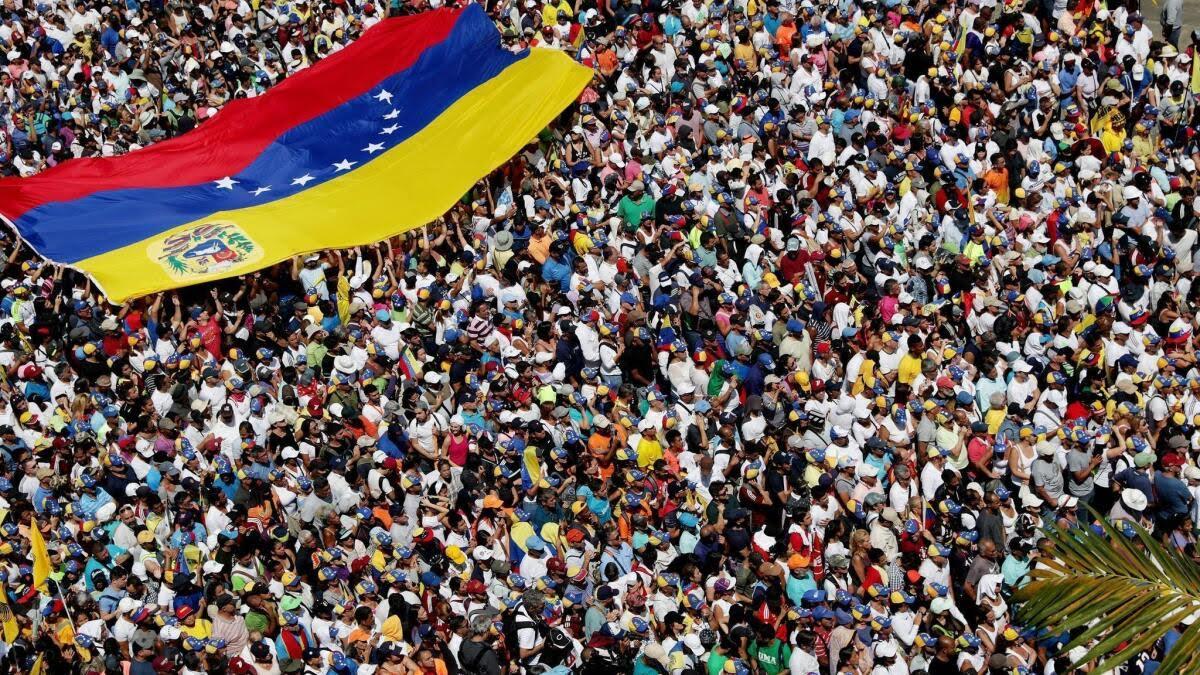
On Thursday, January 22, 2026, the UC Santa Barbara Center for Latin American and Iberian Research (CLAIR) hosted a virtual panel titled “What’s Next for Venezuela?” The event focused on the ongoing crisis in Venezuela and the aftermath of the recent U.S military intervention, examining its political and social consequences.
The discussion featured David Smilde, the Charles A. and Leo M. Favrot Professor of Human Relations and Chair of the Department of Sociology at Tulane University, where he is also a Senior Associate at the Centre for Inter-American Policy and Research; and Leonardo Vivas, a former Director of Industry in Venezuela’s Development Ministry who now teaches Comparative Political Economy at Lesley University. The panel was moderated by Professor Juan Pablo Lupi (Spanish and Portuguese and LAIS).
The speakers analyzed the challenges facing Venezuela’s future, emphasizing the deep institutional fragmentation left by years of authoritarian regime. Panelists noted that the extraction of Nicolás Maduro has not resolved these issues and could, in fact, complicate the efforts of democratic rebuilding. Speakers highlighted the tensions between foreign intervention and Venezuelan sovereignty; there has yet to be a transition of power. They shared some insights from literature on democratic transitions, noting that these often fall into two categories. In one, an authoritarian regime is forced out, while in another, authoritarian power yields to democracy as a result of popular pressure. The situation in Venezuela is a clear example of the first kind.
The panel also explored the possibilities of why the United States decided to invade and force a transition of power. The oil industry plays a crucial role in the country’s political economy and is a driving factor for the United States to extract oil from Venezuela. However, it was also mentioned that there are about 1 million Venezuelans in the United States, and with changes in Venezuela’s political conditions, some Venezuelans living in the U.S. may now return.
The webinar concluded by reflecting on how even countries that claim to uphold democratic values will act in direct contravention of them in pursuit of imperialism. The failures of Venezuela’s democracy under the administration of Maduro, regardless of the harm caused, do not permit a foreign country to illegally invade and depose its leader. Altruism was not the ideology the United States invoked in the capture of President Nicolas Maduro; it was expansionism and weaponized chaos that have left the country’s future in jeopardy. What has happened in Venezuela has created a series of dangerous precedents at home and abroad. These are particularly concerning in a moment when the administration is disregarding domestic law within our borders, for example, with ICE violating citizens’ rights; and on the international stage, like threatening Denmark in contravention of international law and treaties.